


Too High to Thrive: How Excessive Cannabis Taxes Undermine Legal Markets
Legal cannabis is one of the most heavily taxed industries, but a number of efforts to increase taxes have been introduced and passed across the United States. In 2025 alone, California, Maine, Maryland, Michigan, Minnesota, and Ohio all tried to raise or expand cannabis taxes, often framing increases as politically viable revenue solutions amid broader fiscal strain. A similar effort to increase taxes on cannabis sales in Oklahoma was introduced this year.
From small business owners fighting to remain operable to consumers opting for cheaper unregulated products, high taxes are threatening the long-term stability of state-legal markets. Many of these tax hikes emerged as lawmakers confronted budget shortfalls, inflation-driven spending increases, and the winding down of federal pandemic aid.
While cannabis tax revenue funds valuable programs, from education to community reinvestment, policymakers across the country are discovering what the industry has long warned: using cannabis as a budget backstop comes with real tradeoffs. When taxes are too high, everyone loses.
States with Higher Tax Burdens and Complex Tax Structures Are Struggling
When comparing cannabis tax environments and market outcomes across states, clear patterns emerge between taxation levels and legal market participation. Some states like California, Colorado, Illinois, and Washington stack taxes on top of each other:
| State | Sales | Excise | Wholesale | Local | Potency |
| California | 7.25% | 15% | N/A | Rate set by jurisdiction | N/A |
| Colorado | N/A | 15% | 15% | Rate set by jurisdiction | N/A |
| Illinois | 6.25% | N/A | 7% | Up to 3.75% | Up to 25% |
| Washington | 6.5% | 37% | N/A | Up to 3.9% | N/A |
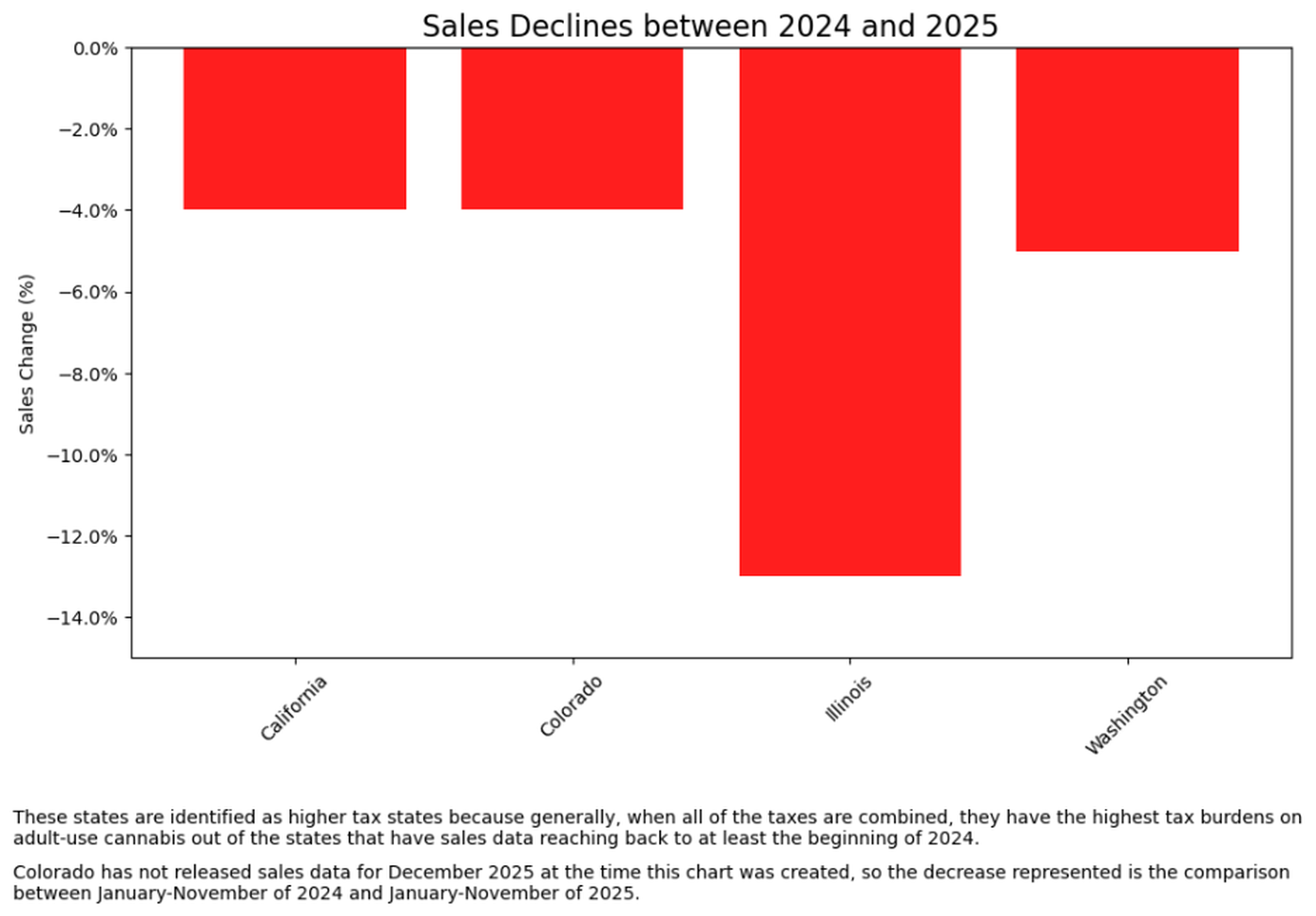
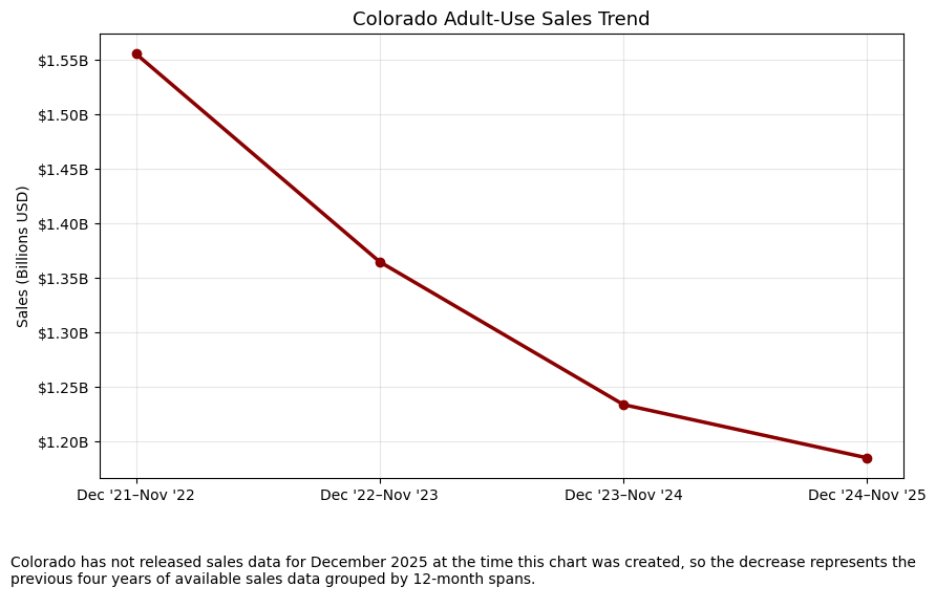
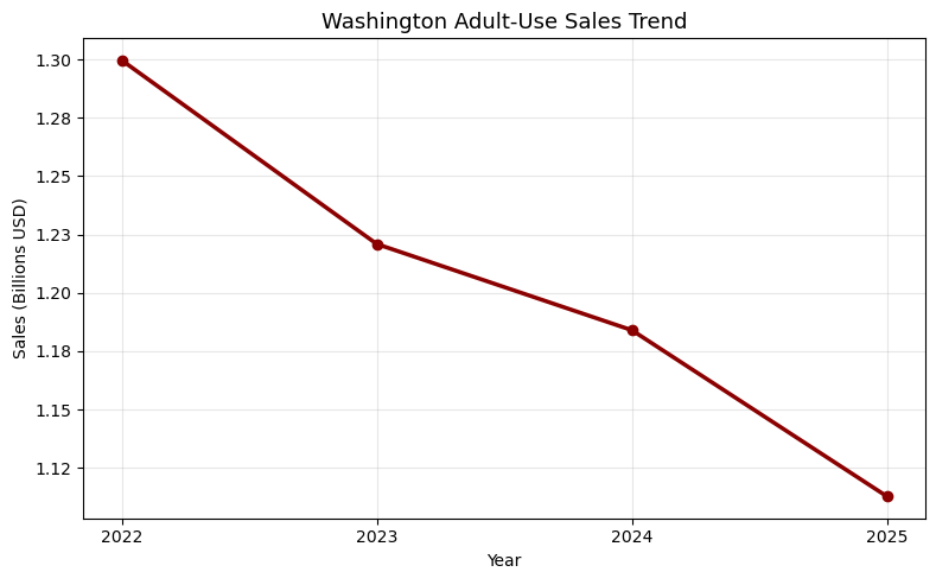
These multiple taxes can make the effective tax rate around 40% in some cases, and are having negative impacts on legal markets. All of these states are seeing adult-use sales declines year-over-year:
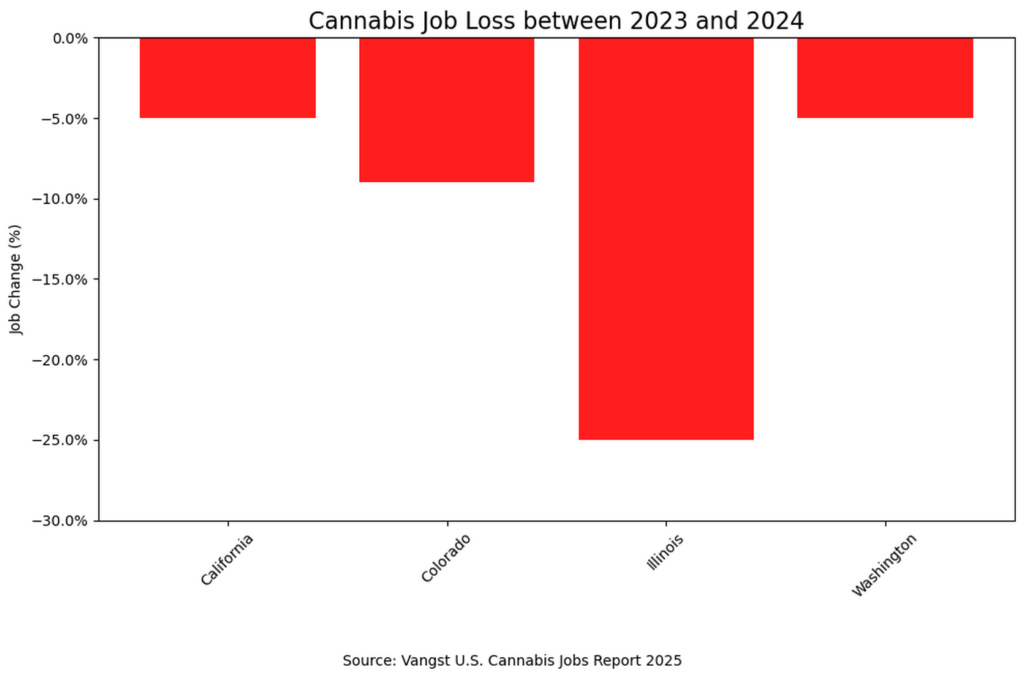
These states also saw industry job losses in recent years:
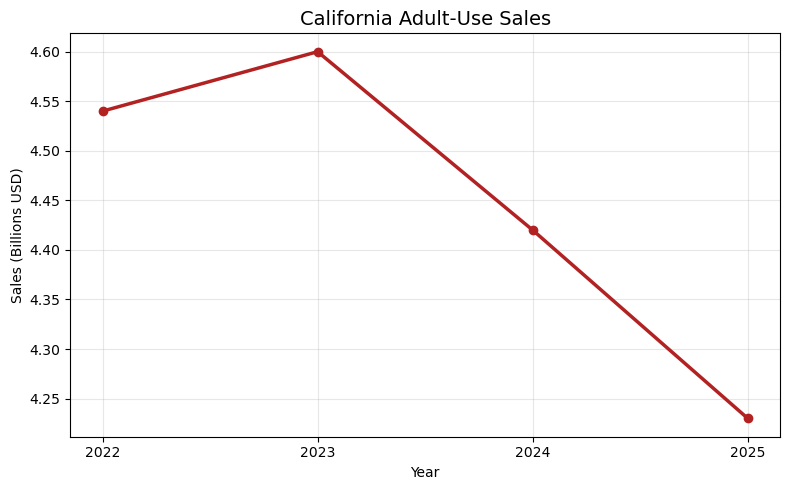
High taxes tend to benefit the illicit market, which goes untaxed. This is particularly notable in California where estimates are that 60% of sales remain in the illicit market. This is not just a recent trend. Many of the states with higher taxes have seen sales decline significantly in recent years:
In addition to the rate, certain types of taxes tend to create either compliance or public health and safety issues. One particularly challenging tax is the THC-based potency tax, which creates both types of issues. Connecticut and Illinois tax cannabis products based on measured THC content rather than price, with higher rates applied as potency increases. Potency tax systems have consistently proven unworkable. They are difficult to administer because tax liability changes with every lab result, creating inconsistent readings, opportunities for manipulation, and added compliance costs for small operators. They also distort consumer behavior by pushing buyers who want higher potency products towards cheaper illicit options. These issues have led to New York eliminating their potency tax in favor of an excise tax on distributors.
States with Lower and Simpler Taxes Are Faring Better
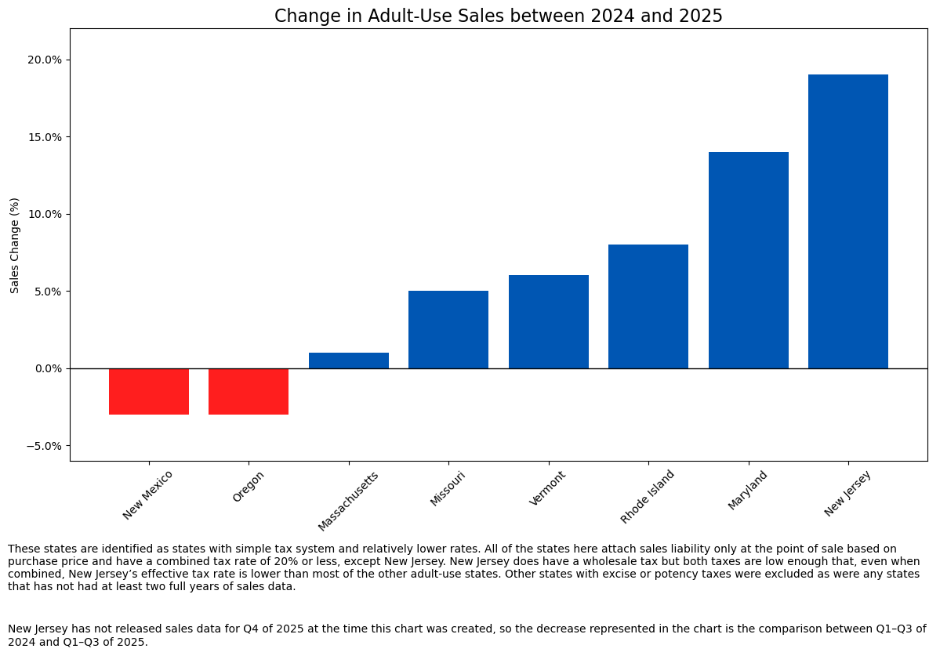
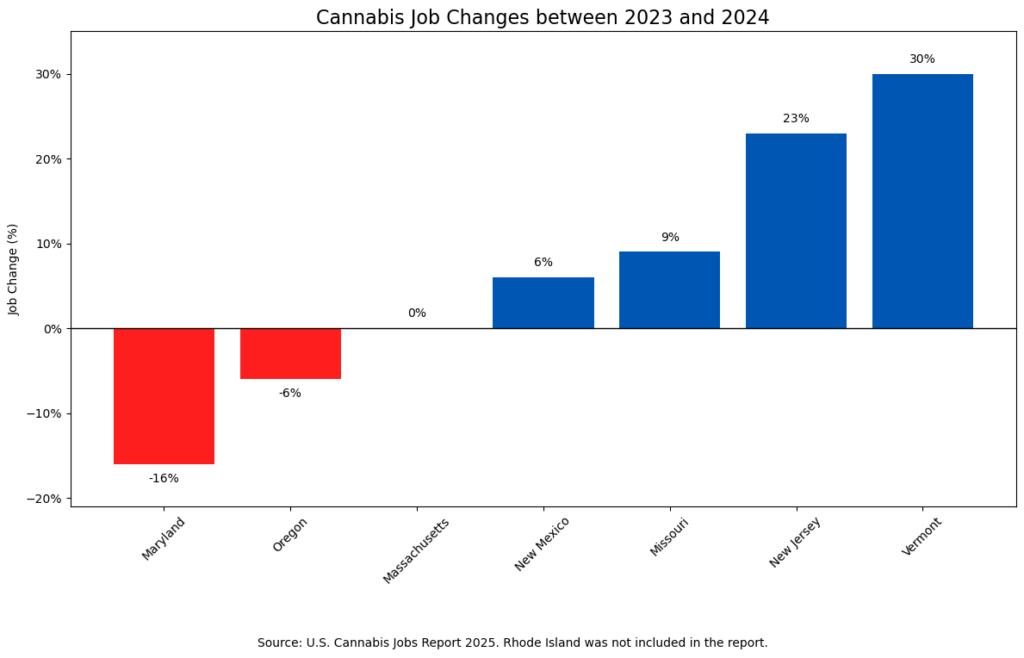
While continued federal prohibition and competition from intoxicating hemp products are impacting the adult-use cannabis industry in states across the country, states with lower tax rates are faring better than those with high taxes in many regards. In states with lower, simpler tax structures, sales often have increased year over year alongside job growth.
States pushing in the wrong direction in 2025
Unfortunately, some states are trying to push their taxes even higher. California raised their taxes but quickly reversed the effort due to the issues it would create in the market. Under the state’s biennial adjustment formula, the cannabis excise tax automatically increased from 15 percent to 19 percent on July 1, 2025 (Cal. Rev. & Tax Code § 34011.2(d)). The industry immediately pushed back, warning that the increase would push more consumers toward unregulated sellers and further destabilize an already fragile market. Within weeks, legislators advanced Assembly Bill 564, which rolled the excise tax back to 15 percent through mid-2028. The measure passed with bipartisan support and was signed into law.
Minnesota’s adult-use market is less than one year old, but lawmakers have already increased the tax burden on cannabis businesses. The state’s FY 2026 budget raised the gross-receipts tax on cannabis from 10 percent to 15 percent, before the state’s first adult-use sales even began. Industry observers worried that the pre-launch hike sent the wrong signal to entrepreneurs and consumers alike. “It’s hard to attract investment when your tax rate jumps before your market exists,” one trade group leader told LeafLine Business Journal earlier this year. With unregulated hemp-derived THC products already widespread and lower-priced cannabis available in nearby Midwest markets such as Michigan, Minnesota’s early tax increase could hamper its ability to transition consumers into a safe, legal market once dispensaries open in 2026.
Where increases have happened, the ramifications have been quickly felt. This was demonstrated recently with a local tax in San Diego, CA. A 10% cannabis business tax was implemented but city revenue from the levy has fallen well short of projections as consumers avoid higher-priced legal products. According to KPBS, the tax has failed to generate expected revenue in part because shoppers remain sensitive to price increases and continue to rely on unregulated sellers, who are not subject to the high operating costs as legal operators. The shortfall underscores a recurring lesson for states and localities considering new cannabis taxes: higher rates can have a negative impact on legal market participation.
Michigan: A Warning Against Overreach
Michigan’s cannabis market has been one of the nation’s success stories, with legal sales accounting for roughly 75 percent of total consumption by late 2023, according to state data cited by Marijuana Moment. But that progress is now in jeopardy.
In October 2025, lawmakers approved a 24 percent wholesale tax on cannabis transfers between wholesalers and retailers that went into effect on January 1, 2026 (HB 4951). The new levy comes in addition to the existing 10 percent excise and 6 percent sales tax, pushing total effective rates near 40 percent. Michigan cannabis retailers reported approximately $227 million in sales in January 2026, a nearly 16 percent decline from December’s $270 million and below the $246 million recorded in January of the prior year, according to data from the Cannabis Regulatory Agency (CRA).
The Michigan Cannabis Industry Association (MCIA) swiftly filed a lawsuit arguing that the new tax violates the voter-approved legalization framework by imposing a revenue measure without the required three-fourths legislative vote.
On December 8, a state court denied MCIA’s request for a preliminary injunction to block the tax from taking effect, allowing the law to move forward while litigation continues. More recently, the Court of Claims denied a motion by the Attorney General’s Office to dismiss the case, Judge Sima G. Patel found that “questions of fact” remain as to whether the wholesale tax violated the will of Michigan voters. This ruling keeps the case active and sends it back to court for further proceedings, while MCIA also pursues a parallel appeal before the Michigan Court of Appeals. (State of Michigan Court of Claims)
“This tax threatens jobs, investment, and consumer safety,” said MCIA Executive Director Robin Schneider in a statement. “We cannot compete with the illicit market if we keep raising prices on legal operators.”
While the state projects tens of millions in new annual revenue, the experiences of other highly taxed states should temper expectations. The new tax will likely reduce sales, cost the state jobs, and generate tax revenue well below projections. Michigan should reverse course before the issues seen elsewhere destabilize their state’s market.
Conclusion
The cannabis industry’s tax dilemma isn’t just about numbers, it’s about survival, equity, and the long-term success of the regulated market. As a number of states demonstrate, tax policy can either stabilize or destabilize a legal market.
Excessive taxation drives consumers away, depresses sales, and limits small-business participation, undermining the goals of safety and economic opportunity that inspired legalization efforts. To avoid these outcomes, lawmakers should prioritize lower, more competitive tax structures that encourage legal market participation, expand compliance, and allow regulated cannabis markets to grow sustainably over time.